The Land They No Longer Want — And the Land They've Already Taken


There is a painful irony at the heart of Britain's housing crisis, and it is one that residents of Hanham understand better than most. Across the country, the major housebuilders are becoming increasingly choosy about the development sites they are willing to pursue.
Faced with squeezed profit margins, rising build costs, and a planning system choked with delay, the giants of UK residential development — among them Barratt Redrow, Persimmon, Taylor Wimpey and Bellway — are now openly prioritising quality over quantity. They will wait, they say, for sites that truly "stack up."
Yet here in Hanham, the developers did not wait. They fought — through two planning applications, more than a thousand community objections, a council refusal, and a full public inquiry — until they got what they wanted.
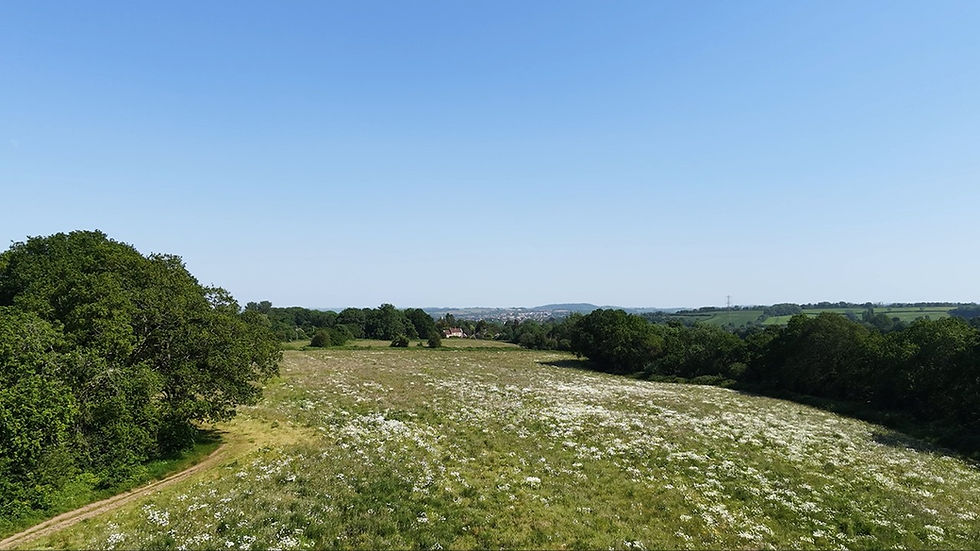
The Planning Inspectorate's decision of 4 July 2025 granted outline planning permission for up to 140 homes on The Batch: 20 acres of Green Belt farmland south of Hencliffe Way and west of Castle Farm Road, adjacent to ancient woodland, a valued green corridor, and the Avon Valley. Inspector Matthew Nunn found that national planning reforms introduced in December 2024 — mandatory housing targets, five-year housing supply requirements, and the newly created "Grey Belt" category — tipped the balance in favour of development. Our Green Belt had become, in the stroke of a policy pen, something called Grey Belt. And that, in the inspector's view, changed everything.
What Is Happening to the UK Housebuilding Industry?
To understand what The Batch decision means for our community, and for Green Belt land across England, it helps to understand the broader pressures reshaping the housebuilding industry right now.
Britain's largest developers are operating in a difficult market. Mortgage rates remain elevated by the standards of the past decade, with the effective rate on newly drawn mortgages sitting around 4.1% in early 2026. Sales rates across the new-build sector have softened, build costs remain high, and the planning system — despite repeated government promises of reform — continues to create uncertainty at every turn. Planning permissions for new homes hit their lowest level in over a decade in 2025, with just 209,781 homes approved across England in the year to September 2025 — 38% below the peak seen in early 2022, and the lowest annual total since 2013. The number of sites approved fell for the twelfth consecutive quarter.
In this environment, the major housebuilders have adopted a discipline that industry analysts describe plainly: they are prioritising profit per plot over pushing output. Research by Savills confirms that land buying has become highly selective, with developers willing to walk away from sites carrying high infrastructure costs, planning risk, or uncertain viability. With the National Planning Policy Framework changes of December 2024 feeding more sites into the southern English planning pipeline, housebuilders have found themselves with more choice — and are using that choice to be more demanding, not less.
Smaller developers and sites in secondary or rural locations are feeling this shift acutely. Savills' Q4 2025 research notes that rural areas in the South West and East of England have seen a particularly pronounced fall in developer appetite, as major housebuilders withdraw from less straightforward markets and concentrate on locations where demand is deepest and returns are most predictable.
For communities like ours, this selectivity carries a pointed message: developers are not building everywhere. They are building where it suits them. And "where it suits them," increasingly, means Green Belt edge-of-settlement land that is accessible, marketable, and — thanks to the Grey Belt — no longer adequately protected.
The Bristol and South West Housing Market
The appeal decision on The Batch did not take place in a vacuum. It was made against the backdrop of a Bristol and South West housing market that is, by most measures, under real but manageable pressure — not in crisis, but certainly strained.
The average house price in Bristol stood at approximately £348,000 in March 2026, according to ONS provisional figures — down around 2.6% from a year earlier, but still well above the South West regional average of £301,000 and far above the UK average of £268,000. New-build properties in the Bristol postcode area commanded a significant premium, averaging around £436,000 in the year to March 2026, up roughly 6% year-on-year — reflecting just how scarce genuinely new homes remain in a supply-constrained city.
Bristol's population is growing. Rents are rising sharply — private rents in Bristol reached an average of £1,885 per month in April 2026, up 8% in a single year. And South Gloucestershire Council, covering the eastern fringe of the Bristol conurbation where Hanham sits, has acknowledged in its draft Local Plan that at least 7,813 new homes will need to be built on greenfield land beyond its urban areas and market towns, some of it currently Green Belt.
These are real housing pressures, and this Society has never argued that new homes should not be built. What we have always argued — and what the Batch decision so painfully illustrates — is that where those homes are built matters enormously. The loss of a Green Belt field is permanent. The communities, the wildlife corridors, the ancient woodlands, and the open vistas that surround Hanham cannot be rebuilt once they are gone.
The Batch: How Green Belt Became Grey Belt
The history of The Batch planning saga is well known to our members. Ashfield Land Ltd and Redrow Homes submitted their first speculative application in April 2023, initially seeking permission for up to 149 homes on the 20-acre site, comprising three agricultural fields behind Hencliffe Way. The application required the demolition of 64 Hencliffe Way — a family home purchased by the developers for £1 million — to create a single access road.
The community responded with extraordinary force. More than 1,567 formal objections were submitted to South Gloucestershire Council. Concerns ranged from the site's Green Belt status and its role as part of a green corridor linking to Hencliff Wood and the Avon Valley, to the impact on local roads, schools, GP surgeries and drainage infrastructure. The Woodland Trust advised that a 50-metre buffer zone from the woodland edge was essential — advice the developers chose to ignore in their revised submission.
The plans were revised in early 2024, reducing the number of homes from 149 to 140. The changes were largely cosmetic. South Gloucestershire Council refused the application in August 2024, on grounds that the site lay outside defined development limits, within open countryside, in the Green Belt, and that the proposal failed to provide adequate on-site and off-site infrastructure.
An appeal was lodged in late 2024. By the time the public inquiry convened in May 2025, the landscape had changed fundamentally. The government's revised National Planning Policy Framework, published in December 2024, had introduced the concept of Grey Belt — defined as Green Belt land making only a limited contribution to the five purposes of the Green Belt. The framework also introduced mandatory local housing targets and strengthened the consequences for councils failing to demonstrate a five-year housing land supply.
South Gloucestershire could show only 3.87 to 4.38 years of housing land supply — below the five-year threshold that now triggers a more permissive planning regime. Inspector Matthew Nunn found that The Batch made only a moderate contribution to preventing urban sprawl (purpose (a) of Green Belt policy) and limited or no contribution to the remaining purposes. On that basis, he designated it Grey Belt. He then found that the proposal met all four criteria for development on Grey Belt land under the revised framework: it would not fundamentally undermine the Green Belt's overall purposes; there was a demonstrable local housing need; the site was in a sustainable location with access to Hanham's services; and the developers' "Golden Rules" package — 50% affordable homes, biodiversity net gain, public open space contributions, and infrastructure payments — met the required threshold for acceptable development.
The landscape harm was acknowledged. The development would urbanise rural land, affect the character of public footpaths, and alter the setting of two Grade II listed buildings nearby. These impacts were judged localised and capable of mitigation. The housing benefits, in the inspector's assessment, outweighed them.
South Gloucestershire Council expressed disappointment with the outcome but accepted it, noting that when they originally refused the plans, the Grey Belt policy and revised housing calculations had not yet been in force. Redrow Homes welcomed the approval.
What This Means for Our Green Belt — and Beyond
The Batch decision is not simply a local setback. It is a case study in how national policy is being used to override community objection, local democratic decision-making, and the very protections that the Green Belt was created to provide.
Consider what happened here. A site that received more than 1,500 objections — one of the most contested planning applications South Gloucestershire Council had seen — was refused by elected local councillors, and that refusal was overturned at appeal by the operation of a policy that did not even exist when the original application was submitted. The rules changed midway through the game. And the community lost.
This is not an isolated incident. Across England, the Grey Belt designation is being applied at appeal to Green Belt sites where councils have failed to demonstrate sufficient housing land supply — which, given the record lows in planning approvals and the government's insistence on steep housing targets, now covers a large and growing number of local authorities. Legal experts and planning consultants are noting case after case where Green Belt land is being reclassified and approved at inquiry under the revised framework.
The broader dynamics of the housebuilding sector make this more concerning, not less. The major developers are becoming more selective — but the sites they are selecting, when they find them viable, are increasingly the accessible, marketable Green Belt parcels on the edges of towns and cities. Edge-of-settlement Green Belt land like The Batch is, in many cases, exactly the kind of site that developers prize: relatively clean ground conditions, proximity to existing services, and, now, a policy pathway to consent that bypasses local objection.
As Savills' analysis noted, with the NPPF changes feeding more sites into the pipeline in southern England, developers can afford to be choosy. But that selectivity cuts both ways: the sites they choose to pursue with determination — as Redrow and Ashfield Land chose to pursue The Batch — are the ones most likely to be fought through to approval, whatever the level of local resistance.
What Comes Next
Outline planning permission has been granted. That does not mean construction is imminent. An outline consent establishes the principle of development and the maximum number of homes; the detailed design, layout, access arrangements, and all the conditions attached to the permission must still be resolved through reserved matters applications. The requirement to demolish 64 Hencliffe Way for access, the single most contentious element of the scheme, remains a live issue in those reserved matters. There is still work to be done, and scrutiny to be applied at every stage.
South Gloucestershire Council is also progressing its new Local Plan, which will shape where development can and cannot take place across the district for the next fifteen to twenty years. The Batch is identified in the draft plan for 125 homes. The Society will continue to press, through the Local Plan examination process, for the strongest possible protections for the remaining Green Belt in our area — and for recognition that the Grey Belt mechanism, as currently applied, risks systematically dismantling protections that took generations to build.
We also call on the government to reflect on what the Grey Belt policy has done in practice. It was introduced with the stated aim of releasing poor-quality, scrubby, degraded land for housing — land described by ministers as "former car parks and wastelands." The Batch is none of those things. It is productive farmland. It adjoins ancient woodland. It forms part of a living green corridor that connects the Avon Valley to the heart of our community. That such land can be reclassified and approved under the Grey Belt mechanism is, we believe, a serious failure of policy design that must be corrected.
Your Role
Hanham District Green Belt Conservation Society has been defending these green spaces since 1981. We opposed the Avon Ring Road, helped secure the protection of Hanham Hills, and have spent four decades ensuring that the Green Belt on the eastern fringe of Bristol remains what it was always meant to be: a permanent, protected resource for the people who live alongside it.
The Batch is a bitter defeat. But the cause is not lost. The Local Plan process continues. The reserved matters stage lies ahead. And the broader national debate about what Grey Belt means — and whether it should be allowed to function as a mechanism for dismantling the Green Belt piece by piece — is very much alive.
We urge every resident who cares about these spaces to join the Society, stay engaged, and make their voice heard. Our Green Belt area is one of just 14 designated in the whole of England. Once it is gone, it will not come back.
Sources: Planning Inspectorate Decision APP/P0119/W/24/3357956 (4 July 2025); ONS UK House Price Index (March 2026); Home Builders Federation Housing Pipeline Report (December 2025); Savills Residential Development Land Research Q3 and Q4 2025; Homes England Investment Roadmap (December 2025); The Week In local reporting, 2023–2025.

Comments