The Batch: Why the Battle Is Not Over

The mounting challenges facing development of 140 homes on Green Belt land south of Hencliffe Way
Planning Application P23/01330/O | April 2026

The appeal for outline planning permission to build up to 140 homes on The Batch — the 20-acre site south of Hencliffe Way and west of Castle Farm Road in Hanham — was allowed
by Planning Inspector Matthew Nunn in July 2025. Hanham District Green Belt
Conservation Society, along with South Gloucestershire Council, opposed the appeal
vigorously. More than 1,500 local residents submitted objections. Despite this, the Inspector
granted permission, citing the Government’s newly introduced “Grey Belt” concept and a
shortfall in South Gloucestershire’s five-year housing land supply.
But an appeal decision is only the beginning. Between a planning permission and 140
completed homes there lies a formidable gauntlet of practical, financial, and physical
obstacles. This bulletin examines why, even with permission in hand, Ashfield Land and
Redrow Homes face a genuinely difficult path ahead — and why the community should
remain alert, engaged, and informed as the reserved matters process unfolds.
A Turbulent Housing Market
Redrow Homes was acquired by Barratt Developments in 2024 to form Barratt Redrow, now
the UK’s largest housebuilder. The timing of that merger coincided with, and in part reflected, one of the most difficult trading environments for residential developers in over a decade.
The national picture is stark. Private housing starts have more than halved, and across
England, total completions in the first half of 2025 fell by nearly 13% compared to the same
period a year earlier. The Government’s ambition of 1.5 million new homes by the end of this
parliament is already well off-pace, with only around 208,600 net additional dwellings
delivered in England in 2024–25 — a 6% decline from the previous year.
For commercial housebuilders, the crux of the problem is demand. When sales slow,
developers cannot sell homes “off plan” — the critical mechanism that generates advance
cash flow and justifies construction lending. With agreed sales in negative territory for much
of 2024 and into 2025, and new buyer enquiries running at deeply negative levels, projects
across the country have been shelved, scaled back, or simply left to stall. Unsold stock ties
up capital; lenders tighten credit on schemes without pre-sales. The result is a vicious cycle
that further depresses housing output.
Mortgage affordability remains the fundamental drag. Despite modest reductions in the Bank of England base rate through 2025, two-year fixed-rate mortgages are still hovering around 4.8–5.2%, and five-year deals around 4.5%. For buyers looking at new-build homes in the Bristol and South Gloucestershire commuter belt, where property prices remain elevated, these rates represent a very significant barrier.
"Housing completions are likely to fall in Q4 2025 and see a much slower start in 2026 than anticipated. — RSM UK"
Housing Tracker, November 2025
All of this bears directly on The Batch. Redrow’s appetite to commit capital to a challenging
greenfield site on former Green Belt land, with a single-access road created by demolishing
a neighbour’s home, will be tempered by the same commercial pressures that have caused
housebuilders to slash starts across the country. Securing construction finance for a scheme
with known ground-condition risks, community opposition, and uncertain sales rates will not
be straightforward.
The Pressure of Construction Costs
Even before a single foundation is dug at The Batch, the cost environment facing any
developer is deeply challenging. Tender price inflation for residential buildings is forecast at
2–4% for 2025, and the cumulative increases since 2020 have left material and labour costs
at historically high levels. Global supply chains have partially stabilised, but prices have not
retreated.
The construction industry faces a shortage of over 140,000 workers, spanning both skilled
trades and professional services. Material shortages are affecting nearly four in five
construction firms — the highest proportion ever recorded in industry surveys. For a site like
The Batch, which will require substantial groundworks (as discussed below), specialist
labour and plant will be essential, commanding a significant premium.
The Building Safety Act continues to impose additional regulatory costs and delays on new
residential schemes. Nationally, the Building Safety Regulator created significant backlogs
throughout 2025, holding up developments across the country. While reforms announced
late in 2025 are beginning to take effect, the regulatory landscape adds cost and programme
uncertainty to any scheme of this scale.
When one adds the cost of off-site highway improvements required as a condition of the
Inspector’s decision — including improved crossing points, bus shelter upgrades, tactile
paving, and footway improvements along Castle Farm Road — alongside the on-site
infrastructure required, the financial model for 140 units at The Batch needs to work very
hard to justify itself in the current environment.
The Affordable Housing Obligation: 50% Is Not a Small Ask
Perhaps the most significant financial constraint facing the developers is the affordable
housing requirement attached to the Inspector’s permission. In granting the appeal,
Inspector Nunn specifically noted that the scheme would deliver 50% affordable housing as
part of the “Golden Rules” applicable to Grey Belt sites under the revised National Planning
Policy Framework.
Seventy homes at affordable or social rent levels sounds like a public good — and it is. But
for the developer, 70 affordable units represent 70 homes that generate substantially less
revenue than market-rate sales. Housing associations, who would typically acquire these
units via Section 106 agreements, are themselves under severe financial pressure. In recent
years it has been widely reported that housebuilders have experienced growing difficulty in
finding registered providers willing to buy Section 106 units on agreed terms, with falling
appetite from housing associations adding further pressure to already fragile development
finances.
The Joseph Rowntree Foundation, in a report published in April 2026, described the
challenge bluntly: rising construction costs are making development unviable in many areas,
while housing associations face the same pressures limiting their financial capacity to
acquire new homes. If a willing housing association cannot be found to take on the 70
affordable units at The Batch on commercially viable terms, the entire business case for the
development unravels.
The community should scrutinise the reserved matters application carefully for any attempt
to renegotiate the affordable housing proportion downwards on viability grounds — a tactic
used widely by developers in more buoyant markets and, in the current climate, even more
likely to be attempted.
50% affordable housing on a site with challenging ground conditions, a constrained single access, and uncertain sales demand: the numbers must add up before a spade enters the
ground.
Ground Conditions: The Hidden Cost Beneath the Fields

The Batch is not clean agricultural land sitting on solid geology. Local knowledge, long
predating this planning application, has established that parts of the site have been used for
infill over many years. Loose shale is present, and areas of ground instability have been
identified. These are not minor concerns. For a residential development scheme, ground
conditions determine foundation design, and foundation design determines cost.
Where ground is found to be unstable — whether through historical tipping, loose shale, or
inadequate bearing capacity — standard strip or trench-fill foundations are insufficient.
Engineers must design piled foundations, raft foundations, or ground-improvement solutions.
Each of these options adds tens of thousands of pounds per plot in direct construction cost.
Across a 140-unit scheme, adverse ground conditions could add millions to the overall build
cost before a single wall is erected.
The developer will be required, as part of reserved matters submissions, to provide detailed
ground investigation reports covering the entire site. The community, and South
Gloucestershire Council’s planning officers, should ensure these reports are rigorously
independent and peer-reviewed. Any attempt to rely on desk-based assessments, rather
than comprehensive intrusive investigations — including trial pits, boreholes, and laboratory
testing of soils across the full site area — should be challenged.
There is also the question of drainage. The site sits in a topographically sensitive position
within the Avon Valley. Sustainable drainage systems (SuDS) will be required. Where soils
are unstable or of low permeability, the design and construction of drainage infrastructure
becomes substantially more complex and costly.
Nature Is Reclaiming The Batch

For thirteen years, The Batch was farmed for maize — an intensive crop that depletes soil
nutrients, compacts the earth, and leaves precious little room for native flora or fauna. Maize
monoculture is widely regarded by ecologists as among the most harmful land uses in terms
of biodiversity, both in terms of soil health and the absence of habitat diversity.
That changed when the land ceased to be farmed. With the cessation of cultivation, the soil
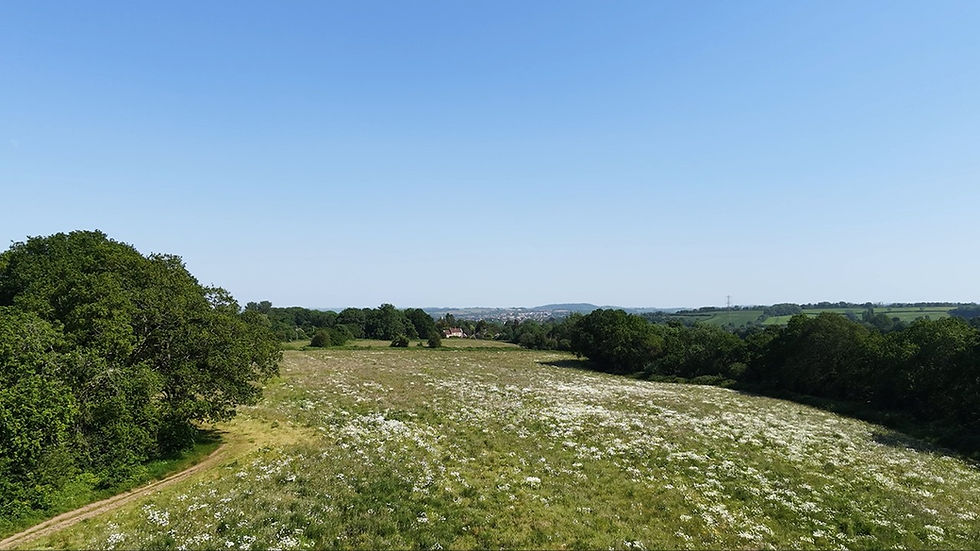
has begun to breathe again. This spring, as any resident walking the public right of way
through The Batch will attest, the land is carpeted with wildflowers — naturally regenerating
species colonising the disturbed ground and hedgerow margins in a way that has not been
seen there for well over a decade.
This natural regeneration is not merely scenic. It is ecologically significant. The presence of
wildflowers at this scale and variety supports pollinators — bees, hoverflies, butterflies —
and represents the early stages of habitat restoration. The proximity of the site to the ancient
woodland of Hencliff Wood to the south and west amplifies this ecological value
considerably. Ancient woodland does not exist in isolation; it depends on its surrounding
matrix of habitats to support the species within it.
The Inspector’s decision acknowledged a required 10% net gain in biodiversity and noted
the proposed planting of native species, a community orchard, allotments, and public open
space. These commitments must be scrutinised carefully at the reserved matters stage. A
developer-commissioned biodiversity metric should not simply be taken at face value. The
baseline used, the species richness of the current sward, and the measurable long-term
commitments must all be independently verified.
It is deeply ironic that, having been subjected to intensive agricultural use that stripped the
land of ecological value, The Batch is now — precisely at the moment it is being sought for
development — beginning to recover. The community’s task is to ensure that this recovery,
however fragile and recent, is given the weight it deserves in all future planning
considerations.
A field of wildflowers this spring is not just beauty. It is evidence of what The Batch can become — given time, and the chance to breathe.
The Inspector’s Decision: Permission, Not a Promise
It is important that the community understands what the Inspector’s decision does and does
not mean. Outline planning permission has been granted. This means the principle of
residential development has been accepted. It does not mean that 140 homes will be built.
Reserved matters must still be submitted and approved. These cover the detail of layout,
scale, appearance, landscaping and access. Every one of these matters is subject to further
scrutiny. South Gloucestershire Council’s planning officers retain the power to negotiate,
condition, and where appropriate refuse, reserved matters applications that do not comply
with the conditions of the outline consent. The conditions imposed by the Inspector are
extensive and technically demanding.
Among those conditions: a detailed ground investigation report, an updated energy
statement, confirmation of photovoltaic systems, air source heat pumps, detailed biodiversity net gain calculations, and a full range of highway and drainage details. Each of these involves significant cost and regulatory risk. Each is an opportunity for the community to engage, examine, and where necessary object.
Furthermore, outline permissions lapse if reserved matters are not submitted within three
years. In a market as challenging as the current one, with a developer facing the full weight
of costs described above, it is entirely possible that the scheme does not proceed at the
pace — or at all — that the Inspector’s decision might suggest.
Conclusion: Engaged, Informed, and Ready
The Batch has outline planning permission. That is a setback, and the Society acknowledges
it plainly. But it is not the end. The challenges that face this development — a fragile housing market, relentless cost inflation, a 50% affordable housing obligation, potentially unstable ground, and a community and ecology that are both fighting back — are real and significant.
Hanham District Green Belt Conservation Society will continue to monitor every stage of
the reserved matters process. We will engage with South Gloucestershire Council’s planning
officers, scrutinise ground investigation reports, challenge any attempt to water down
affordable housing commitments, and ensure that the natural recovery now underway across
The Batch is given its proper weight in every submission that follows.
We urge all members and supporters to remain subscribed to our updates at
hanhamgreenbelt.com, to walk The Batch this spring and witness the wildflower recovery for
themselves, and to be ready to engage when the reserved matters applications are
submitted. Your voices were heard over 1,500 times during the outline stage. They will
matter just as much in the stages to come.

Comments